Summary of The State of AI-assisted Software Development Report
This year’s edition, of the DORA research, entitled State of AI-assisted Software Development, focused on the impact of AI assistance on software development.
What is DORA
DORA is the largest and longest-running research program, analyzing IT organizations of various sizes and in many different industries around the world each year.
The researchers used a rigorous statistical evaluation methodology to identify the common characteristics of successful companies. The analysis covered practices and factors affecting the effectiveness of teams involved in software development.
Full report available at dora.dev/research/2025/dora-report.
AI Is Already the Standard, but It Doesn’t Replace Thinking
AI in software development is no longer an experiment: 90% of surveyed developers use AI at work, and more than 80% report increased productivity.
At the same time, as many as 30% of respondents have low trust in AI-generated code, which demonstrates a mature approach to verifying the results of AI “work.”
AI genuinely accelerates development, but it requires critical thinking and solid engineering practices.

AI Amplifies What’s Good — and What’s Bad
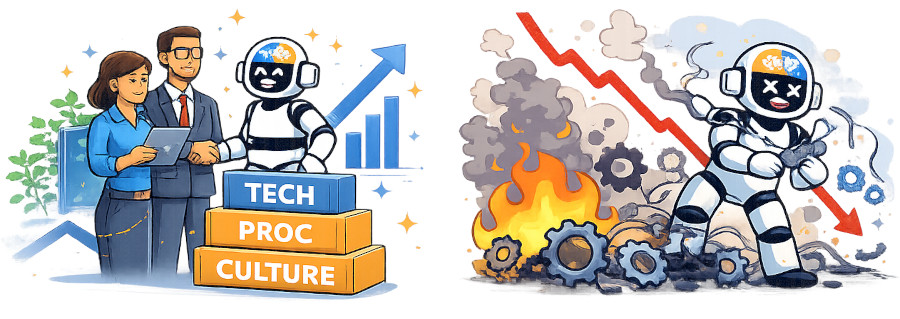
The key takeaway from the report: AI does not fix systemic problems — it amplifies them.
Organizations with strong architecture, clear processes, and a healthy work culture gain the greatest benefits. Where chaos, technical debt, or poor collaboration prevail, AI leads only to local improvements that get lost in later stages of delivery.

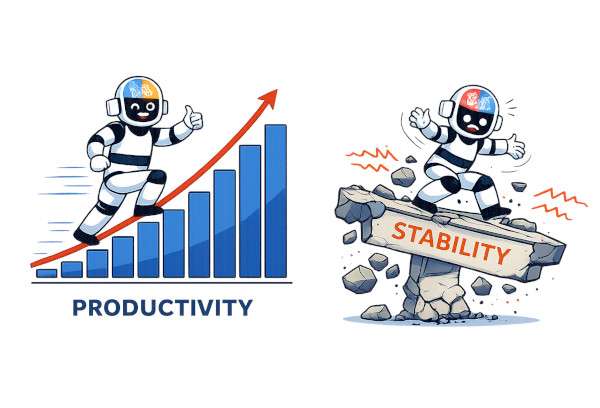
With AI, Productivity Increases — but Stability Still Suffers
In 2025, for the first time in DORA research, AI genuinely increases throughput (the speed of delivering changes).
At the same time, an increase in delivery instability is still being observed (more rollbacks, hotfixes, and unplanned work).
This signals that teams have learned to write code faster with AI, but quality control and feedback systems are not keeping pace with this pace.
Platform Engineering Is the Foundation of AI Success
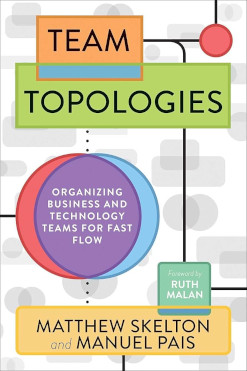
As many as 90% of organizations have adopted platform engineering, following the concept introduced in the book Team Topologies.
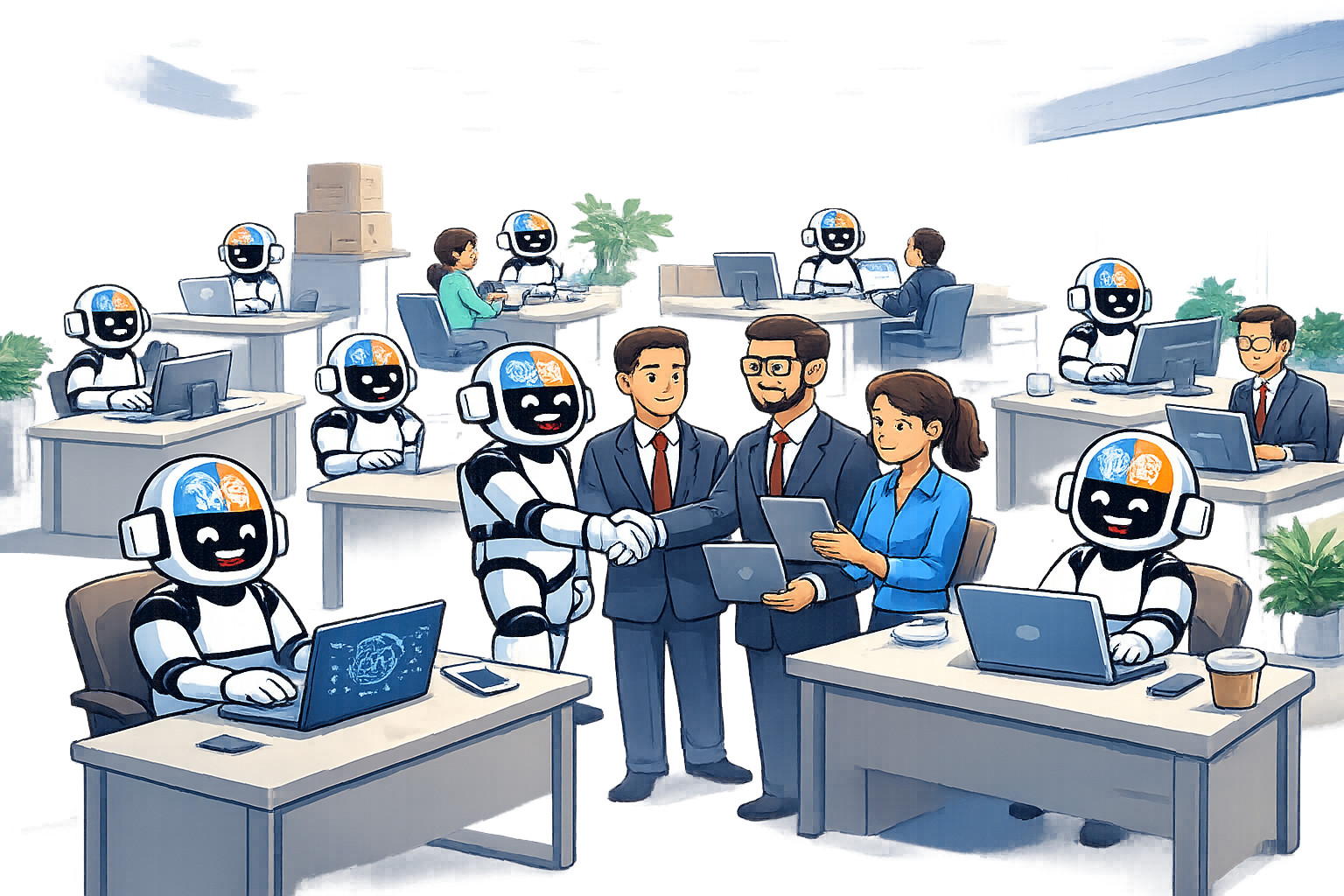
The report clearly shows that the quality of the internal developer platform is crucial for realizing tangible benefits from AI.
Additionally, Value Stream Management (VSM) acts as a “force multiplier” — it enables organizations to convert local time savings (e.g., faster code writing) into real business outcomes, rather than generating more downstream chaos.
AI Adoption Is an Organizational Transformation
The greatest return from AI comes from investing in the system — not merely in models or licenses.
The new DORA AI Capabilities Model identifies seven key capabilities that determine success:
- A clear and well-communicated AI position
- Working in small batches
- Healthy data ecosystems
- User focus
- Internal data accessible to AI
- High-quality internal platforms
- Strong version control practices
Summary
AI is now a standard part of software development, but it does not solve organizational problems. It acts as an amplifier: the best teams become even better, while weak systems become even more chaotic.
Real value from AI is achieved only by organizations with solid technical, process, and cultural foundations.
 Share on Facebook
 Share on Twitter
Stay up to date!
Get all the latest & greatest posts
delivered straight to your inbox